


Better catalysts don’t sell themselves: A conversation with Eelko Brevoord
Eelko Brevoord, a former Albemarle Catalysts research director, explains why superior catalysts rarely win on performance alone, why partners matter more than patents, and where the next openings in fuels, plastics and chemicals may lie.

Only a few products in a refinery are as invisible as the catalyst. It is a modest line in the cost sheet, yet it strongly determines how much diesel, jet fuel or base oil is resulting from every barrel. It is also one of the hardest markets to enter. Established suppliers have decades of scale and market presence behind them, refiners favor what they know, and a new catalyst material can outperform in the lab but still struggle to get a first trial. For a scale-up like Zeopore, which improves zeolite catalysts through mesoporization, that is daily reality. We asked Eelko Brevoord, who has seen the catalyst market from the inside, how innovation really finds its way in.
From refinery floor to research director
Eelko Brevoord started his career at an oil refinery, where he used catalysts long before he developed and sold them. He then joined Akzo Nobel for an international career: technical sales and service, covering countries across Europe, then India, Southeast Asia, Australia and later China. He grew into managing technical service and R&D, and finally became research director, leading a team that developed and tested new catalysts in large pilot plants. The business changed names along the way (Akzo Nobel, Albemarle, today Ketjen), but not its purpose.
In 2020 Eelko left to start his own consultancy on the interplay between refining and catalysts. Here you find his website: https://brevoord-consultancy.nl/
Today Eelko advises oil companies and catalyst producers on laboratory testing aspects, pilot-plant work, catalyst tenders and plant troubleshooting. For Zeopore, he helps set up pilot and lab tests and judges what better zeolite quality is actually worth to a customer, from cracking to hydrocracking and (lube) dewaxing.
Performance products, bought on price
Ask anyone in the industry and they will say catalysts are about performance. Brevoord sees a contradiction.
“Everybody says that catalysts are performance products, but many of them buy them on price.”
The reason is partly practical. Many refiners only have a paper study to go on, and anyone can claim a better product. So new incumbents fall back on credibility, industrial test cases and price. Those customers that do test extensively, still watch the bill: apart from crude oil and salaries, the catalyst is one of the largest costs a refiner carries. If two candidates look equal, the cheaper one wins, which makes it hard to earn a return on a superior but costlier product.
Testing adds its own uncertainty. Results carry an error margin, so a promising result has to be repeated, and a disappointing one may only mean bad luck.
“One test is no test.”
Partners really open doors
Brevoord has launched new technologies himself, and he says convincing others to adopt them was always the hard part. Refining and petrochecmical companies are very risk-averse, and the incumbent supplier has to show that the catalytic benefit (value) outweighs the risks and cost-of-change. A reputable, market-present co-developer makes that far easier.
“If you develop a technology together with, for instance, a refining catalyst company, that international company will be very much willing to try it out and to introduce it commercially to the end)customers.”
Another hurdle is the licensor. Refineries that run a licensed unit, tend to buy their catalyst from the licensor and value its service, so an independent supplier struggles to break in unless it goes through that licensor. Strong partners can offset this: a big company with its own market knowledge can open doors far easier than which a small one cannot open alone.
That logic shows in Zeopore's own collaborations. Working with Evonik as high-tech catalyst producer gives Zeopore a partner that knows the chemical markets and has the scale and customer relationships to match. Catalyst buyers are risk-averse, and a technology backed by a trusted company is easier for them to adopt.
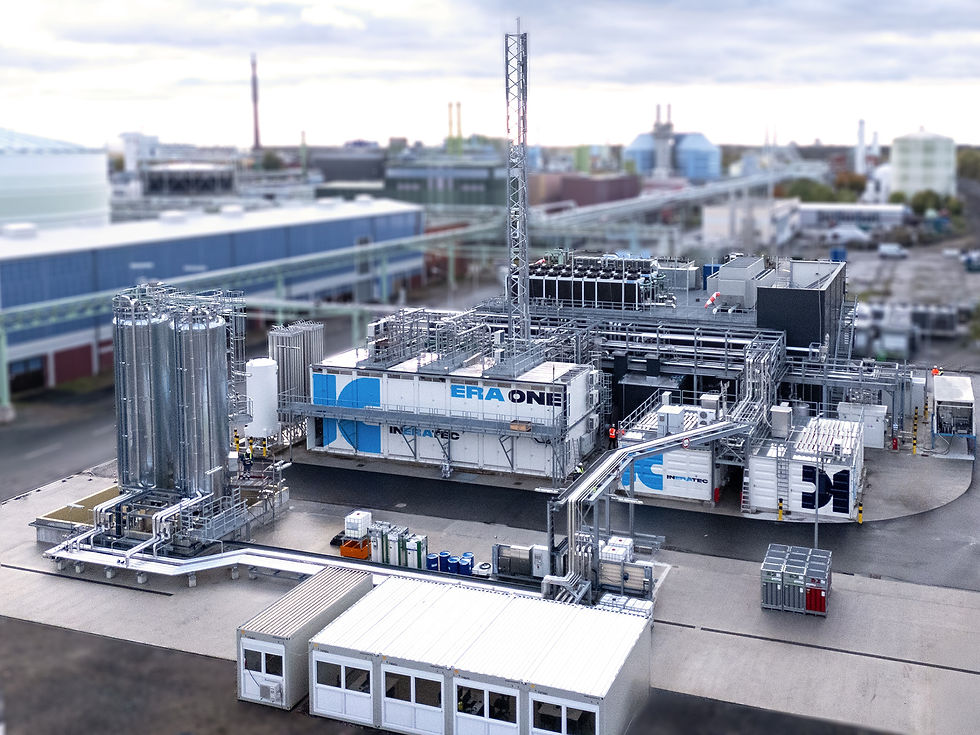
With INERATEC, a leading developer of e-fuel technology, the first phase of hydrocracking Fischer-Tropsch oils is complete and a larger second phase follows. Brevoord calls it “the right area to play a role in.”
The market keeps moving the goalposts
Is there still room to improve catalysts that have existed for decades? Brevoord points to the S-curve: early on, big gains come quickly, and some products dating back to the Second World War are near the end of their curve. The great thing is that, new customer demands or environmental requirements reset the course:
Heavier feeds: as fuel oil demand faded, refiners upgraded the ‘bottom of the barrel’ to a large degree, needing more performing catalysts in demanding conditions.
Cleaner fuels: the fear of acid rain in the 1980s and early 1990s brought strong restrictions of sulfur-containing fuels, leading to an enormeous boost in catalyst development.
Renewables: today already, converting renewable oils and animal fats into biodiesel and sustainable aviation fuel is driving new catalyst innovations, where we expect that e-fuels and pyrolysis may be next.
“The market can also, at a certain moment, give a strong swing to new catalysts again.”
In Europe, he notes, sustainability is a hot topic. Elsewhere, cheap fossil fuel often makes it hard for alternatives to compete.
Where he would look next
Asked where he would focus on behalf of Zeopore, Brevoord refers to "first focus areas": dewaxing, hydrocracking and lube manufacturing, plus high-value chemicals whose production would gain a lot of financial and efficiency gain from better selectivity.
Biofuels stay on his list. Flying on batteries, he says, is unattractive because of their low energy per weight, so sustainable aviation fuel “stands the best chance,” with more plants arising. Green hydrogen, made by electrolysis, may not need much catalyst.
Waste plastics are a tougher puzzle. Contamination is the problem: PVC brings chlorine, which can corrode equipment and poison catalysts. Recycling also costs more than making plastics from fossil sources, so legislation usually has to push it. Yet, he sees little alternatives if climate neutrality by 2050 is the goal, and an effective conversion route could open a large market.
Closing with the takeaway
The lesson is unglamorous but clear: a technically superior catalyst is the start of the work, not the end. Proof that holds up across repeated tests, a partner willing to share the risk, and a segment that pays for quality all matter as much as the chemistry behind the catalyst.
“If you have a great technical idea, it doesn’t necessarily mean that it sells on its own. It takes an enormous effort to become successful.”
Brevoord believes Zeopore understands this well, but also has the technology, network and momentum to make it work. He advises sustainable refiners and high-quality catalyst producers to engage with Zeopore for the next generation of performing catalysts. .


Comments